
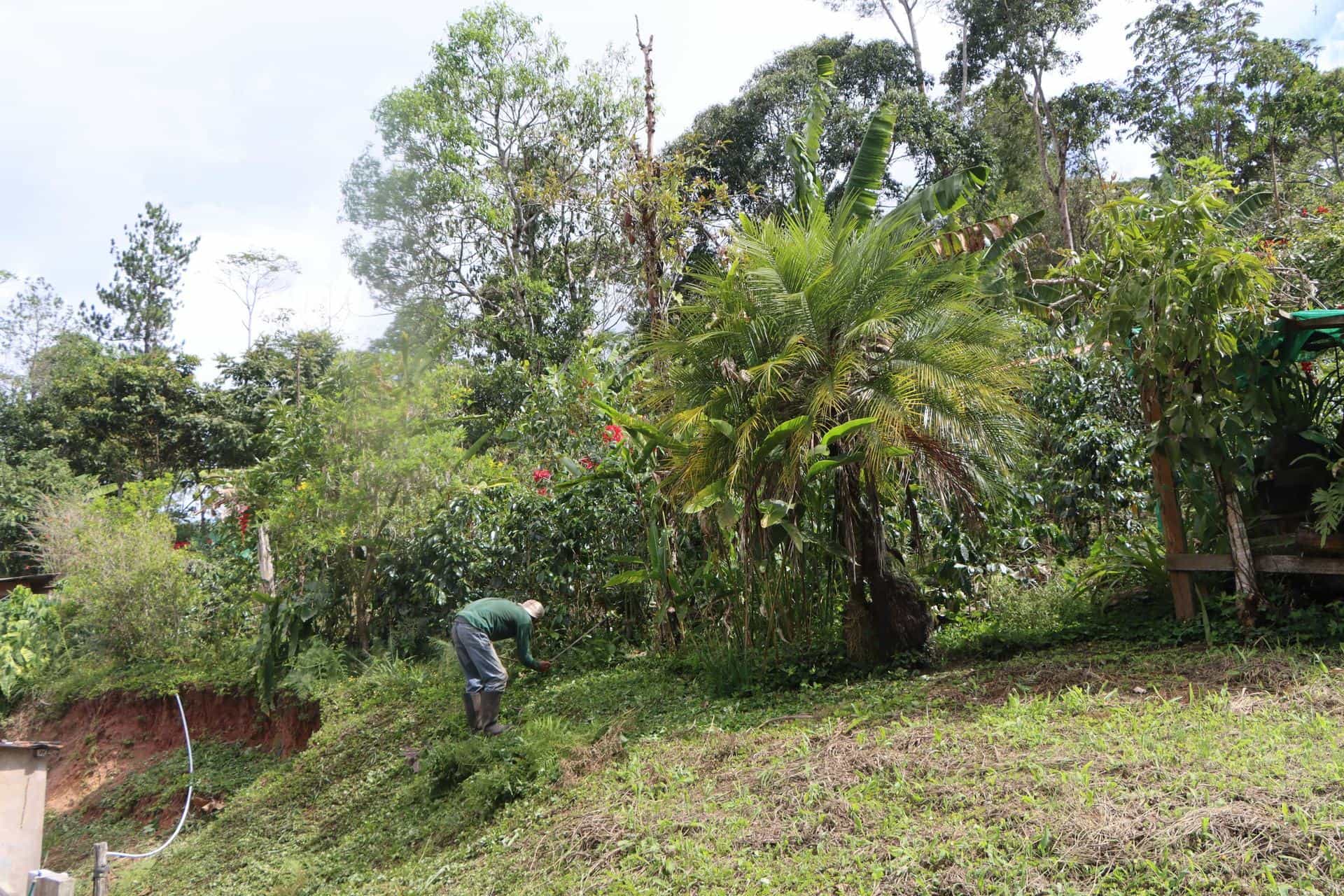
 Foto: Danitza Medina Velásquez · CC BY-SA 4.0
Importer Journal · Responsible sourcing
Coffee Traceability: From the Plot to the Container
Traceability means you can follow a lot back to the plots it was grown on. For EU buyers it is now a legal requirement: from 30 December 2026 the EUDR asks for the geolocation of every plot. We deliver it as GeoJSON with the certificate of origin, and the lot keeps its identity from the farm to the container.
By Enrique Hans Barraza Mohring · Flor de Altura ·
Traceability is where sustainability starts
Every other sustainability claim depends on it. Without knowing which plot a coffee comes from, nobody can say whether forest was cleared for it, who grew it or how they were paid. Traceability is not a feature on top of a sustainable coffee: it is the condition for saying anything about it.
What the EUDR asks for
The EU Deforestation Regulation, (EU) 2023/1115, applies from 30 December 2026 to large and medium operators and from 30 June 2027 to micro and small ones. From then on, green coffee can only be placed on the EU market with a due diligence statement.
That statement relies on origin data: the geolocation of every plot (a point for plots up to 4 hectares, a polygon above that), the production period, and the information needed to show the coffee is deforestation-free after 31 December 2020 and was produced in line with Peruvian law.
What we deliver with each lot
- Plot geolocation as a GeoJSON file, the format the EU Information System accepts.
- The certificate of origin of the shipment, issued for the export from Peru.
- Delivery as a file or as a digital token, on request and agreed with your compliance team.
- Answers to the questions of your risk assessment.
Who files the due diligence statement
The operator who places the coffee on the EU market, usually the importer. We supply the data it relies on. We do not claim a deforestation-free certification: we provide the geolocation and the chain of custody so that you, or your verification provider, can check it against the cut-off date.
A chain with few hands
The fewer handovers, the fewer chances to mix lots or lose their identity. Our second lot, Perené 82.75, was processed and cupped at our partner dry mill, Procesadora Los Inkas, in Chanchamayo. The mill loads the coffee straight into the container, with no intermediate warehouse or handling.
For the importer
If your coffee is going to the EU, say so when you request samples. We agree from the start how the geolocation data reaches your compliance team, so it does not become a last-minute task.
Frequently asked questions
In what format do you deliver plot geolocation?
As a GeoJSON file, the format the EU Information System accepts, together with the certificate of origin of the shipment. It can also be shared as a digital token, on request and coordinated with your compliance team.
Is your coffee certified deforestation-free?
We do not claim a deforestation-free certification. We provide plot geolocation and traceability from the farm to the container so that you, or your verification provider, can check it against the 31 December 2020 cut-off date.
Cup it before you commit
Tell us your volume, destination port and target profile. We send cupping samples before any contract and reply within one business day.
FLOR DE ALTURA S.A.C. · RUC 20614458411 · Pichanaqui, Chanchamayo, Junín – Peru